
10 Things to Consider Before Starting Your Christmas Grotto
A Santa’s grotto is one of the few places a family will happily queue to have a photo taken, and then pay for it. In a world where more and more memories are trapped inside a phone – this is a once in year to get a physical print handed to you there and then. Get the photography right and it can pay for the grotto. Get it wrong and you have a queue out the door and a printer out of paper on the last Saturday before Christmas.
DLK Photo has supplied photographers and event operators since 1973, and every autumn we help Christmas Grottos of all sizes get set up. These are the ten things we talk through before anyone orders anything.
1. How many visitors will you see, and how fast must the queue move?
Start with the numbers, because they decide everything else. Multiply families per hour by opening hours by days open. A garden centre seeing 30 families an hour, six hours a day, for 20 days will take 3,600 photos. A school Christmas fair on one Saturday might take 150. The one thing we know is that 95% of people attending will buy a photo if priced correctly
Those two grottos need different printers, different amounts of paper and different numbers of staff. Write your estimate down before you look at any equipment.
Then find your peak. Most grottos are busiest on the last weekends before Christmas, so plan for your busiest hour, not your average one. If each sitting takes two minutes from sitting down to walking away, one camera position handles about 30 families an hour. If you expect more than that, you need a second position or timed ticket slots.
2. Should you buy or hire?
Buy if you photograph events all year. A printer that also works weddings, proms and school photos earns its keep, and bundles with printer, paper and wireless printing start under £1,250 ex VAT.
Hire if you only need the kit for five or six weeks, you are going to be super busy and you need a smooth throughput. Hire systems generally operate on a hire fire and a cost per print basis, if the plan is to do 2000+ prints and the event maybe a 1-off, hire systems are worth considering. Our Grotto & Event System can be hired for the Christmas period. It arrives preconfigured, runs software built for Grottos, and comes with remote technical support.
Do the sums over three years, not one. Bought kit costs more in year one and very little after that, but you have to store it, look after it and set it up again each November. Hired kit costs the same every year, arrives ready to run and goes back in January.
There is a sensible middle route. Hire for your first season, learn your real numbers, and buy in year two once you know what you need.
3. Which printer, and what size of print?
Dye-sublimation printers are the grotto standard. Prints come out dry and ready to handle in seconds, with no ink to smudge on small fingers.
Three DNP printers power almost all the grottos we supply. Which one you need depends on the size of your event.
| Printer | Best for | Why |
| DNP QW410 | Parish halls, school fairs and smaller community grottos | Low cost, small and light enough to carry in and set up on a table |
| DNP DS620 | Larger grottos and shopping centres where versatility is key | Prints several sizes from one machine, so you can offer 6×4, and 6×8 packages |
| DNP DS-RX1HS | Larger grottos and shopping centres where throughput is king | Built for volume, with high-capacity rolls that mean fewer paper changes and a low cost per print |
As a rule, start with the QW410 if you are running a weekend event on a budget. Move to the DS620 if your packages need different print sizes, but restrict the print size to two options – 6*4 & 6*8. Choose the RX1 if you sell one size all day either 6*4 or 6*8 and the priority is keeping a long queue moving.
Choose your print size before anything else. A 6×4 is the cheapest to produce and fits most photo gifts such as snow globes, glitter frame and bauble. The gold standard is 6×8 feels more special in a mount and supports a higher price point – adding a branded option ads even more value. Whichever you pick, check that your mounts, frames and gifts are made for that size.
Wireless printing is worth having. Sending photos straight from the camera, phone or tablet to the printer means fewer cables for children to trip over. That said many Grottos prefer the security and simplicity with cabled set ups.
Order paper for prints, not for families. If a family buys a mounted print and a snowglobe, that is two prints from one sitting- this ‘upsell’ is where grottos can get really profitable, but adds a degree of complexity that hire systems solve hassle free. Multiply your visitor estimate by the prints in your most popular package, then add a margin for reprints and test shots.
4. Where will the camera and lights go?
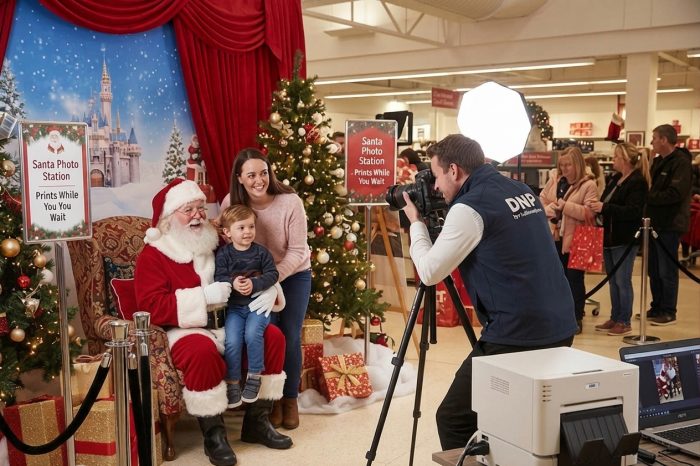
Grottos are dark by design, and cameras do not like the dark. Decide where the photographer stands, how far that is from Santa’s chair, and whether you will use flash or constant lighting. Check where the nearest power sockets are.
One fixed camera position with one fixed light gives you the same good photo every time, which keeps the queue moving. Test it at the time of day you will be open.
Plan for your subjects as well as your kit. Small children wriggle, cry and look at their parents instead of the lens. Flash freezes movement, and a helper standing beside the camera gets eyes looking the right way. Take several frames of every family and pick the best.
Leave room for prams and wheelchairs to get in and out without moving the lights.
5. What will be behind Santa?
You have three choices:
- A built set. It looks the best and costs the most in time and space.
- A paper or fabric backdrop. Festive colours on a roll are cheap, quick to hang and easy to replace when they get scuffed.
- A green screen. Software drops in any digital background, so you can offer a different scene with each package. It needs even lighting to work well. For us this option just doesn’t work. There is something innocent real and authentic about the Grotto Experience and green screen to us is at odds with this
Whichever you choose, check the width. A family of five needs far more backdrop than one child on Santa’s knee.
Look at what else is in the frame. Fire exit signs, sockets and shop shelving all show up in a photo that a family will keep for years. And remember that families come back: a fresh backdrop each year gives last year’s customers a reason to buy again.
6. What will you sell beyond the print?
The photo is where the sale starts. A print in a Christmas mount or folder is your basic package. Snowglobes, glitter frames, tree ornaments, baubles, keyrings and magnets turn the same photo into a present for the grandparents.
These gifts come by the box, with cutters that trim the photo to fit in one press. Plan two or three packages at clear prices before opening day. Keep the menu short, because a queue cannot wait while someone chooses between nine options.
A simple ladder works well: a print in a folder/mount, 3 prints (covers both grandparents) a print plus one gift, and two prints plus a gift. Work out your cost per item from the box price before you set the selling price.
7. Who does what?
There are three jobs: taking the photo, printing and assembling it, and taking payment. In a small grotto one person can do two of them. Nobody can do all three with a queue waiting.
Decide whether families pay before the photo or after they have seen it. And because you are photographing children, agree in advance how you ask parents for consent and how long you keep the images. Check the safeguarding rules that apply to your venue and your staff.
Run a full rehearsal before opening day. Use staff as families and time the whole thing, from sitting down to walking away with a photo. Write the steps on one page for seasonal staff, because the person who was trained in November is not always the person working on Christmas Eve.
Cash maybe king but make sure you can take cards. Most families expect to tap.
8. When will you order, and what is your backup?
Order early. Popular gift designs sell out well before December, and hire systems should be booked as soon as your dates are fixed. Generally we aim to have all our customers orders in by the end of October, stock maybe at a premium come November/December.
Keep spare paper on the shelf and know how quickly you can get more. We hold key items in stock for same-day despatch. Finally, always have a contingency plan if something stops working such as a spare printer or camera. Downtime means lost revenue.
A backup plan does not need to be complicated: a second memory card, a spare camera battery, a spare box of paper, and a way to take a family’s details and send the photo on if the printer is down.
9. What already works for other grottos?
Success leaves clues. The grotto market is well defined, and you do not need to reinvent the wheel.
Before you design anything, visit two or three established grottos as a paying customer. Watch how the queue is managed, where the camera sits, what the packages are and what they cost. Notice what families walk out carrying, because that tells you what sells.
Then apply it to your own context. A shopping centre’s set-up will not drop straight into a village hall, but the principles carry over: a fixed photo position, a short menu, and a finished gift in the family’s hands within minutes.
Ask your supplier as well. We see what dozens of grottos order each season, so we can tell you which formats and gifts are proven before you spend money finding out.
10. Is this your first year? Keep it simple
This is the most important point on the list. If it is your first grotto, do not try to be too clever.
One backdrop. One print size. Two packages. A set-up your team can run without thinking. That is enough to give families a good photo and to give you a profitable season.
Do not try to be all things to all people. Every extra option is one more thing to stock, explain, price and get wrong while a queue is waiting. Complexity kills grottos far more often than bad photos do.
Accept that you will make mistakes. Everyone does in year one. Keep a notebook by the till and write down what ran out, what nobody bought and where the queue stalled.
Then evolve. Year two is when you add the green screen or the third package, because now you know your numbers. The best grottos we supply were refined over three or four seasons. None of them got there by doing everything at once.
Your grotto checklist
- Visitor estimate: per hour, at peak and for the whole season
- Buy or hire decided
- Print size chosen, with mounts and gifts to match
- Camera position and lighting tested
- Backdrop chosen and wide enough for a family
- Two or three packages priced
- Roles, payment and consent agreed, and a rehearsal run
- Stock ordered, spare paper on the shelf, support number saved
- Two or three established grottos visited, and what works noted
- First-year plan kept simple, with a notebook ready for next year’s changes
Planning a grotto this year? Everything above is in our Christmas shop, to buy or to hire. Call us on 028 9077 4455 or email info@dlkphoto.co.uk and we will help you work out what you need.

Comments are closed here.